An active optical cable (AOC) has many advantages such as high transmission rate, long transmission distance, low energy consumption, and convenient use. It can replace passive optical cables or copper wire-based cable systems to be applied in high-density and high-bandwidth situations and has become the ideal transmission cables for data centers, consumer electronics and other fields.
However, active optical cables can be classified into various types according to different specifications and speeds, such as 200G QSFP-DD AOC, 100G/50G QSFP28 AOC, 56G/40G QSFP AOC, SFP28 AOC, and so on. So, what are their characteristics and what are their categories? This article will give a detailed introduction to QSFP+ AOC cable and its categories.
What is QSFP+ AOC?
QSFP+ AOC is an efficient integrated cable assembly product designed for short-distance multi-channel data communication and interconnection applications. Its communication distance ranges from 1 to 100 meters and it is suitable for supercomputers and SDR, DDR, QDR and other applications based on InfiniBand standards. Moreover, active optical cables have more significant advantages over interconnected copper cables, such as lower transmission power on system links, only one-fourth of the weight of direct-connected copper cables, slightly half the volume of copper cables, better air flow and heat dissipation in the cabling system of the computer room, smaller bending radius, longer transmission distance, and lower bit error rate of the product transmission performance.
Key Features and Benefits
Integrated design with built-in optical modules and fiber
Short-range connectivity from 1 to 100 meters
Low power consumption compared to copper cables
Lightweight and flexible, ideal for high-density cabling
Excellent signal integrity with low bit error rate
Hot-swappable, plug-and-play installation
Lower overall cost for short-distance applications
High reliability and consistent performance
QSFP vs QSFP+
| Feature | QSFP | QSFP+ |
| Full Name | Quad Small Form-factor Pluggable | Quad Small Form-factor Pluggable Plus |
| Max Data Rate | Up to 20 Gbps (4 × 5 Gbps typical) | Up to 40 Gbps (4 × 10 Gbps) |
| Per-Channel Speed | 2.5/5 Gbps | 10 Gbps |
| Primary Applications | InfiniBand SDR/DDR | 40G Ethernet, InfiniBand QDR/FDR |
| Form Factor | Both share the same mechanical form factor. | Both share the same mechanical form factor. |
| Backward Compatibility | Not forward compatible with QSFP+ | Backward compatible with QSFP (device dependent) |
| Current Market Usage | Phased out in most new deployments | Still deployed, gradually replaced by QSFP28 and higher-speed variants |
*Compatibility depends on equipment vendor and firmware support.
What are the Categories of QSFP+ AOC?
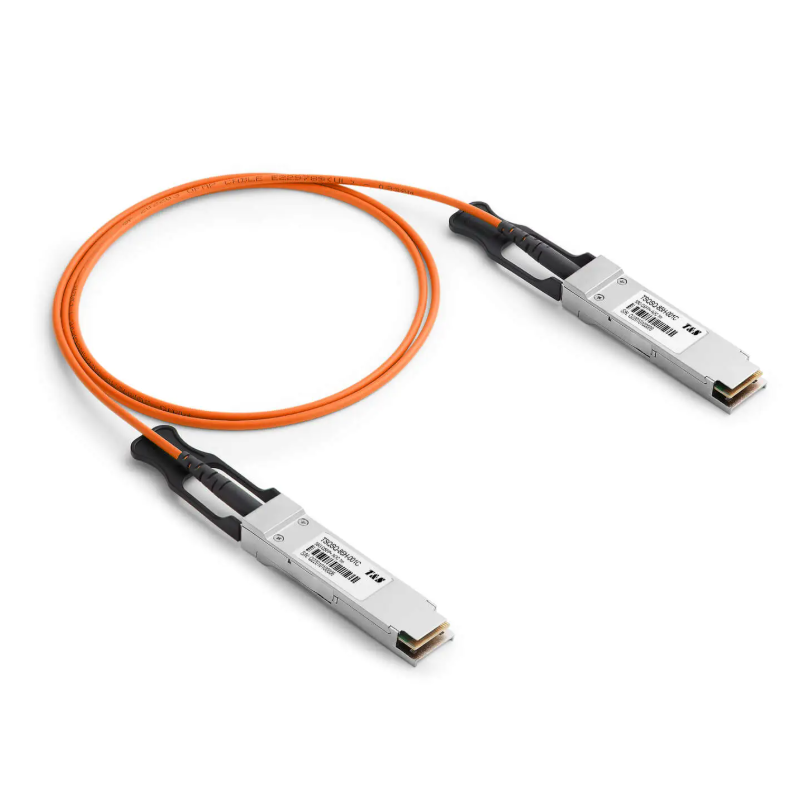
(1) 56G QSFP+ AOC
56G QSFP+ AOC: QSFP+ FDR active optical cable has a built-in 850nm VCSEL laser, PIN array, integrated driver and receiver chip. It supports the standards including InfiniBand FDR, 10G Ethernet, SAS2.0 and SAS3.0, 8G and 10G fibre channel. The transmission distance of OM3 optical fiber is 100 meters, and that of OM4 optical fiber is 150 meters. It is 100% perfectly compatible with a full range of brand servers, switches, routers, PDH/SDH transmission equipment, EPON, GPON, 10G EPON, 10G GPON and WDM PON base stations.
Its product features are as follows:
Full-duplex 4-channel 850nm active optical cable; transmission data rate of 14.0625gbit/s/channel; set trigger SFF-8436 QSFP+ compatible; hot-swappable electrical interface; 4-channel 850nm VCSEL array; 4-channel PIN photodetector array; OM3 multimode fiber (MMF) with a maximum link length of 100m and OM4 MMF of 150 meters; low-power shell and connector; 0°C + 70°C working temperature; 3.3 V power supply voltage; RoHS6.
(2) 40G QSFP+ to 4X10G SFP+ AOC
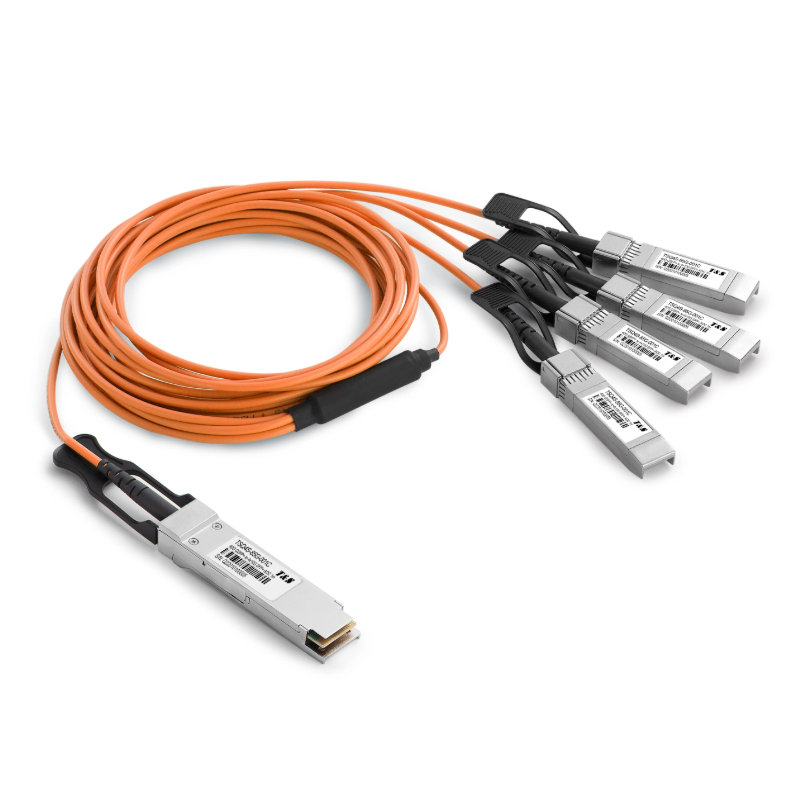
40G QSFP+ to 4X10G SFP+ AOC provides IT professionals with cost-effective host adapters, switches, and servers enabled by combining 40G QSFP and 10G SFP+.
For typical applications, users can install this breakout active optical cable between the QSFP ports on their 40Gbps rated switches and provide four upstream 10 gb/s-sfp+ enabled switches.
Each QSFP-SFP+ split active optical cable is characterized by a QSFP connector (sff-8436) at one end and SFP+ connector (SFF-8431), which are rated 40Gbps (SFF-8436), which is 10gb/s respectively.
The product features are as follows:
The electrical interface is compatible with QSFP+ connector (setting trigger-8436) and SFP+ connector (setting trigger-8431); hot pluggable; 850nm VCSEL transmitter, PIN laser detector; OM3 MMF up to 100m; operating temperature: 0-70℃; excellent EMI performance of all metal shell; RoHS6 (lead-free).
(3) 40G QSFP+ AOC
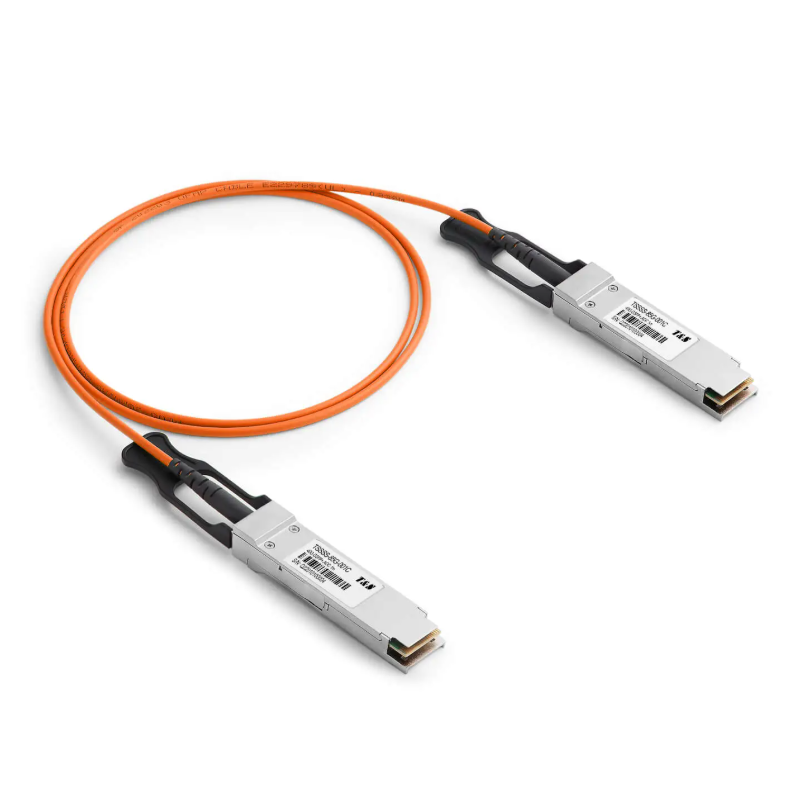
40G QSFP+AOC is the core component to realize parallel optical interconnection. It consists of ribbon fiber jumpers connected to two high-speed 40G parallel connectors. Each signal direction has 4 data channels, and each channel can work at the speed of 10Gbps. Its transmission distance is generally 1 to 100m.
Advantages of 40G QSFP+ AOC:
Compared with traditional 40G copper cables, 40G active optical cables have incomparable advantages: high transmission efficiency, small size, light weight, and low energy consumption;
Compared with the optical transceiver, the AOC has no cleaning problem when the connector fails, and there is no need to test the terminal plug, which can help users save more time;
AOC QSFP has better cabling consistency and repeatability. The closed ends are easier to avoid the influence of environment and vibration. If there is a failure, it can be replaced directly, saving costs;
AOC is generally cheaper than optical transceivers. It can save deployment costs, and the transmission distance can also meet the requirements of a variety of short-distance transmission applications.
QSFP+ AOC is a mature and widely adopted interconnection solution for short-distance, high-bandwidth applications. With advantages such as low power consumption, lightweight design, easy installation, and high reliability, QSFP+ AOCs play a critical role in modern data centers and HPC environments.
By offering multiple configurations, such as 56G QSFP+ AOC, 40G QSFP+ AOC, and breakout QSFP+ AOC solutions, QSFP+ AOCs provide flexible options to meet diverse network architectures and performance requirements.
FAQs of QSFP+ AOC
What is QSFP+?
QSFP+ (QSFP full form is Quad Small Form-factor Pluggable) is a high-speed, hot-pluggable optical interface that supports four parallel data channels. Each channel can transmit up to 10 Gbps, enabling a total bandwidth of 40 Gbps. QSFP+ is widely used in data centers, high-performance computing, and InfiniBand-based systems for short- to medium-distance interconnections.
What are QSFP types?
QSFP-28: designed for use with 100G Ethernet applications
QSFP-DD: a double density version of the QSFP module, with increased connector density and higher data rates
QSFP56: supports speeds of up to 56Gbps per channel, suitable for high-speed data transmission applications
What fiber type is used in QSFP+ AOC cables?
QSFP+ AOCs typically use OM3 or OM4 multimode fiber (MMF). OM3 supports transmission distances up to 100 meters, while OM4 can extend the distance up to 150 meters, depending on the data rate and application.
Are QSFP+ AOCs hot-swappable?
Yes. QSFP+ active optical cables support hot-plugging, allowing installation or removal without powering down the system. This feature simplifies maintenance and improves operational efficiency.
Where are QSFP+ AOCs commonly used?
Data centers
High-performance computing (HPC) systems
InfiniBand SDR, DDR, QDR, and FDR applications
Switch-to-switch and server-to-switch connections
High-density, short-distance interconnection scenarios
 EN
EN
 jp
jp  fr
fr  es
es  it
it  ru
ru  pt
pt  ar
ar  el
el  nl
nl 
 Fiber Optic Flex Circuit (FOFC)
Advanced Simulation & Optimization, High Positioning Accuracy, Flexible Customization, Rigorous Reliability Testing
Fiber Optic Flex Circuit (FOFC)
Advanced Simulation & Optimization, High Positioning Accuracy, Flexible Customization, Rigorous Reliability Testing MDC Solution
US Conec's MDC connector is a Very Small Form Factor (VSFF) duplex optical connector, expertly designed for terminating single-mode and multimode fiber cables with diameters up to 2.0mm.
MDC Solution
US Conec's MDC connector is a Very Small Form Factor (VSFF) duplex optical connector, expertly designed for terminating single-mode and multimode fiber cables with diameters up to 2.0mm. MMC Solution
US Conec's Very Small Form Factor (VSFF) multi-fiber optical connector that redefines high-density connectivity with its cutting-edge TMT ferrule technology and intuitive Direct-Conec™ push-pull boot design.
MMC Solution
US Conec's Very Small Form Factor (VSFF) multi-fiber optical connector that redefines high-density connectivity with its cutting-edge TMT ferrule technology and intuitive Direct-Conec™ push-pull boot design.


