A fiber optic attenuator is a passive device used to reduce the power level of an optical signal in free space or in an optical fiber. Although fiber optic attenuators are commonly used in SM (single mode) links, since this is where stronger lasers are used for distance transmission, multimode fiber attenuators are also available.
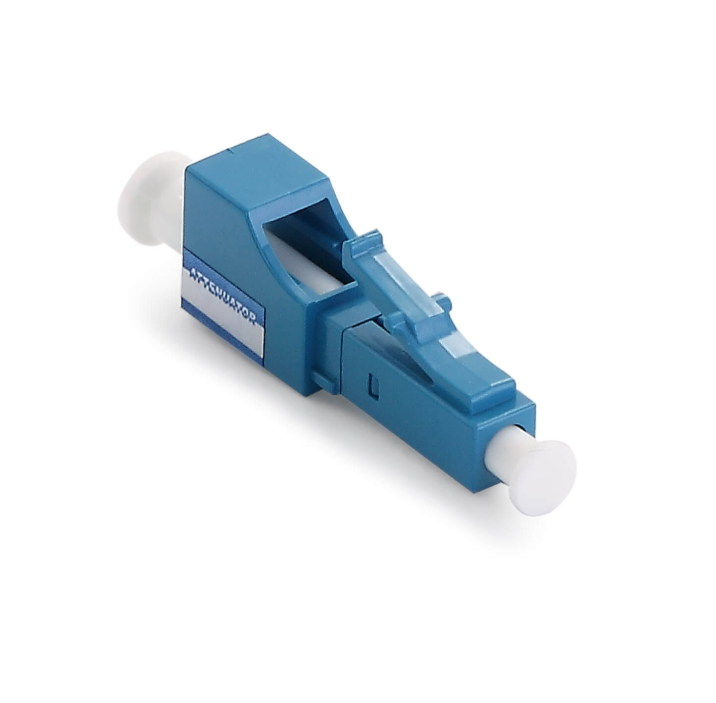
The most common version of attenuators is male-to-female. These plug-type attenuators are simply installed on one end of a fiber optic cable, allowing the fiber optic cable to be plugged into a receiving device or panel. There are also female-to-female (male) attenuators, typically used to install in a patch panel or to connect two fiber optic cables together. Fiber optic variable attenuators are more expensive but useful for testing and can be adjusted from 1dB to 30dB. dB rating is a measure of signal strength because sometimes you can confuse it with others.
Two Common Applications of Fiber Optic Attenuators
The first case is in a power level test. To test power level margins in fiber optic communication systems, optical fiber attenuators are used to temporarily add a calibrated amount of signal loss.
In the second case, optical attenuators are permanently installed in the fiber optic communication link to properly match the optical signal levels of the transmitter and receiver.
What are the Optical Attenuator Types?
Optical attenuators are generally categorized by their adjustability and form factor.
Fixed Optical Attenuators: Deliver a consistent, unchanging level of light loss (e.g., 5dB, 10dB, 15dB). These are highly stable and cost-effective.
Preferred methods: Doped fibers or misaligned splices, most reliable.
Legacy methods: Gap-los, less stable, sensitive to dust and temperature.
Variable Optical Attenuators (VOA): Allow for real-time adjustment of signal loss, typically from 1dB to 30dB.
Manual VOA: Adjusted via a screw or dial, ideal for testing.
Electrically Controlled VOA: Used in advanced dynamic network management.
Plug-Style (Male-to-Female): The most common type. It looks like a standard connector but has a built-in attenuating element. One end is a male plug, the other is a female socket.
Bulkhead (Female-to-Female): Functions as a coupler and an attenuator simultaneously, typically installed in patch panels.
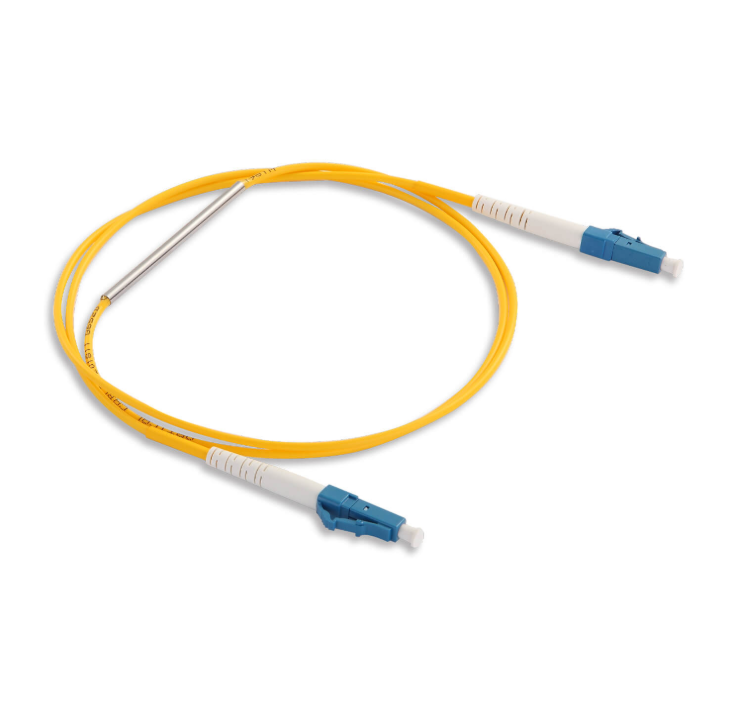
In-line Attenuators: Built directly into a fiber optic patch cord, providing a neat, fixed-loss cable solution.
Loopback Attenuators: Specifically designed for testing and burn-in stages of network equipment. They loop the signal from the transmitter back to the receiver to test link integrity.
| Feature | Fixed Attenuator | Variable Attenuator |
| Best for | Permanent links | Testing & Lab environments |
| Cost | Low | High |
| Stability | Excellent | Moderate |
| Ease of Use | Plug-and-play | Requires calibration |
Fiber optic attenuators are indispensable components for maintaining the integrity and performance of optical networks. Whether you are using fixed attenuators for permanent link balancing or variable optical attenuators for rigorous laboratory testing, choosing the right fiber optical attenuator type is critical to preventing receiver saturation and ensuring a healthy link budget.
As fiber optic technology continues to evolve toward higher speeds and longer distances, the demand for precision and reliability in passive components has never been higher. For those seeking high-quality, industry-standard optical solutions, T&S Communications provides a comprehensive range of attenuators in optical fiber and advanced connectivity products. By integrating premium components from trusted manufacturers like T&S Communications into your infrastructure, you can ensure your network operates with optimal signal clarity and long-term stability.
FAQs of Fiber Optic Attenuator
What are the different types of optical attenuators?
Fixed Attenuators: Provide a predetermined level of signal loss (e.g., 5dB or 10dB). They are available in various form factors like Plug-style (Male-to-Female), Bulkhead (Female-to-Female), and In-line configurations.
Variable Optical Attenuators: Allow users to manually or electronically adjust the attenuation level (typically from 1dB to 30dB), making them ideal for testing and laboratory environments.
What is the difference between 1310 and 1550 attenuation?
1310nm Wavelength: Typically experiences higher attenuation (approx. 0.35 dB/km). It is commonly used for shorter-distance transmissions.
1550nm Wavelength: Experiences lower attenuation (approx. 0.22 dB/km), making it the standard for long-haul and DWDM applications.
High-quality attenuators are often wavelength-independent or dual-window, meaning they are calibrated to provide the same precise dB loss at both 1310nm and 1550nm to ensure system consistency.
What are the 3 types of attenuation in optical fiber?
In fiber optic communication, signal attenuation is generally caused by three physical mechanisms:
Absorption: Caused by residual impurities, like water molecules, in the glass fiber that absorb light energy and convert it into heat.
Scattering (Rayleigh Scattering): Occurs when light hits microscopic variations in the density of the fiber glass, causing the light to scatter in different directions.
Bending Loss (Macrobending & Microbending): Occurs when the fiber is bent too sharply, causing the light to escape the core and leak into the cladding, resulting in signal power loss.
 EN
EN
 jp
jp  fr
fr  es
es  it
it  ru
ru  pt
pt  ar
ar  el
el  nl
nl 
 Fiber Optic Flex Circuit (FOFC)
Advanced Simulation & Optimization, High Positioning Accuracy, Flexible Customization, Rigorous Reliability Testing
Fiber Optic Flex Circuit (FOFC)
Advanced Simulation & Optimization, High Positioning Accuracy, Flexible Customization, Rigorous Reliability Testing MDC Solution
US Conec's MDC connector is a Very Small Form Factor (VSFF) duplex optical connector, expertly designed for terminating single-mode and multimode fiber cables with diameters up to 2.0mm.
MDC Solution
US Conec's MDC connector is a Very Small Form Factor (VSFF) duplex optical connector, expertly designed for terminating single-mode and multimode fiber cables with diameters up to 2.0mm. MMC Solution
US Conec's Very Small Form Factor (VSFF) multi-fiber optical connector that redefines high-density connectivity with its cutting-edge TMT ferrule technology and intuitive Direct-Conec™ push-pull boot design.
MMC Solution
US Conec's Very Small Form Factor (VSFF) multi-fiber optical connector that redefines high-density connectivity with its cutting-edge TMT ferrule technology and intuitive Direct-Conec™ push-pull boot design.


